

 Deutsch
 Español
 Suomi
Suomi Français
 Bahasa Indonesia
 Italiano
 日本語
日本語 Português
 Tagalog
Summary
N-acetylcysteine, or NAC, is an acetylated derivative of cysteine that sits between the drug and supplement worlds. It is not a required dietary nutrient, and its strongest roles are medical: NAC is an established antidote for acetaminophen overdose and a recognized mucolytic in settings with thick secretions.
As a consumer supplement, NAC is often marketed for antioxidant, glutathione, liver, respiratory, and mental wellbeing support, but the evidence is uneven. COPD and chronic bronchitis findings are modest and inconsistent, PCOS results are promising but limited, and psychiatric or addiction-related uses remain condition-specific and still emerging. Dose, route of use, safety, and regulatory context all matter.
Quick Facts
What is it useful for?
Best established as a medical antidote for acetaminophen overdose and as a mucolytic. Supplement evidence is more tentative for COPD, PCOS, and some psychiatric adjunctive uses.
Supplement types
Most consumer products are oral capsules, tablets, powders, or effervescent forms. Prescription acetylcysteine also exists as oral solution, inhaled solution, and IV products.
Interactions
It should not be casually combined with NAC-containing medicines. People using nitroglycerin, carbamazepine, or other prescription therapies should check with a clinician first.
Side effects
Oral NAC most often causes nausea, vomiting, diarrhea, reflux, gas, and an unpleasant sulfur smell. Inhaled and IV forms have additional route-specific risks.
Other possible benefits
Possible but still unconfirmed benefits have been studied in PCOS and in some psychiatric or addiction-related settings, usually as an add-on rather than a stand-alone treatment.
Regulatory status
In the US, FDA uses enforcement discretion for certain NAC supplements despite its drug history. In the EU, claims are tightly controlled and country treatment may vary.
What We Already Know About It
Core mechanism. NAC is a thiol-containing, acetylated cysteine derivative that can serve as a cysteine donor for glutathione synthesis and can also participate directly in redox biology. This helps explain why it is discussed in oxidative stress, mucus-related conditions, and disrupted cellular signaling. Oral NAC has relatively low bioavailability, often cited around 6 to 10 percent, so gram-level study doses are common and should not be assumed equivalent to inhaled or IV acetylcysteine products. Sources: Antioxidants review on NAC bioavailability; Cell Death Discovery review on NAC
Established clinical role. The strongest evidence is not general wellness use but specific medical care. NAC is a standard antidote for acetaminophen poisoning and is also used as a mucolytic in selected settings with thick secretions. These uses are backed by clinical guidance or prescription labeling and are qualitatively different from broad claims about routine liver cleansing or everyday respiratory optimization. Sources: StatPearls — Acetylcysteine; JAMA Network Open guidance on acetaminophen poisoning; DailyMed — acetylcysteine inhalation and oral solution
What remains uncertain. Outside those established indications, the evidence is more variable. COPD and chronic bronchitis research suggests at most modest and inconsistent benefit, mainly around exacerbation-related outcomes rather than lung function. PCOS studies show some promising metabolic effects, while psychiatric and addiction-related findings are mixed, adjunctive, and condition-specific. The overall picture is biologically credible but not uniformly proven. Sources: PubMed — 2017 COPD meta-analysis; PubMed — 2023 COPD meta-analysis; PubMed — 2024 multicentre COPD trial; Systematic review of NAC in PCOS; Journal of Clinical Psychiatry meta-analysis; Meta-analysis of NAC in substance-use disorders
Summary of Relevant Scientific Research
What NAC Actually Is — Cell Death Discovery review
The review clarifies that NAC is the N-acetylated derivative of cysteine rather than a natural food nutrient, helping separate sulfur amino acid nutrition from NAC marketing as if it were an essential dietary requirement. Cell Death Discovery review on NAC
Best-Supported Medical Use — StatPearls and JAMA Network Open
Clinical references identify acetylcysteine as the core antidotal treatment for potentially toxic acetaminophen overdose, especially when given promptly. This is the clearest evidence-backed use and should not be confused with broad liver-detox supplement claims. StatPearls — Acetylcysteine; JAMA Network Open guidance on acetaminophen poisoning
Respiratory Evidence Is Mixed — Cochrane review and COPD analyses
Long-term NAC has shown possible modest reductions in COPD or chronic bronchitis exacerbations in some analyses, but lung-function and quality-of-life results have been inconsistent. More recent meta-analytic and trial data did not show clear benefit across key respiratory outcomes. Cochrane review on mucolytics; PubMed — 2017 COPD meta-analysis; PubMed — 2023 COPD meta-analysis; PubMed — 2024 multicentre COPD trial
PCOS Shows Promising Signals — Systematic review and meta-analysis
Across 11 randomized trials involving 869 women, NAC was associated with improvements in fasting glucose, fasting insulin, and some lipid markers. The findings are encouraging, but short follow-up and limited study settings keep the evidence from being definitive. Systematic review of NAC in PCOS
Psychiatric and Addiction Findings Stay Uneven — Meta-analyses and phase III trial
Meta-analytic data suggest possible adjunctive benefit for depressive symptoms and some addiction-related outcomes, but studies are heterogeneous and condition-specific. A larger phase III trial in obsessive-compulsive disorder found no symptom benefit, which supports a cautious interpretation. Journal of Clinical Psychiatry meta-analysis; PubMed — phase III OCD trial; Meta-analysis of NAC in substance-use disorders
Beliefs, Myths & Unproven Claims
NAC is a required nutrient from food
This is misleading. NAC is a modern derivative of cysteine, not a classical dietary essential like a vitamin, mineral, or indispensable amino acid. The relevant food nutrients are sulfur amino acids such as methionine and cysteine from protein-containing foods. Cell Death Discovery review on NAC; Journal of Nutrition review on sulfur amino acids
NAC is a proven general detox or liver-cleanse supplement
NAC is strongly established for a specific emergency use: acetaminophen poisoning. That does not mean routine supplementation generally detoxifies the liver, and supplement labels cannot legally present NAC as a disease treatment. StatPearls — Acetylcysteine; JAMA Network Open guidance on acetaminophen poisoning; FDA — structure-function claims
NAC reliably improves COPD and lung function
Respiratory claims are often overstated. Some studies suggest possible modest effects on exacerbations, but lung-function and quality-of-life outcomes have been inconsistent, and more recent evidence has been mixed. Cochrane review on mucolytics; PubMed — 2017 COPD meta-analysis; PubMed — 2023 COPD meta-analysis; PubMed — 2024 multicentre COPD trial
NAC is a settled treatment for mental health or addiction
The evidence is more nuanced than online marketing suggests. Some adjunctive psychiatric and substance-use studies are encouraging, but findings are heterogeneous, and a phase III OCD trial was negative. Journal of Clinical Psychiatry meta-analysis; PubMed — phase III OCD trial; Meta-analysis of NAC in substance-use disorders
NAC has a long traditional-use pedigree
NAC is not an ancient botanical remedy or a classical nutrient with centuries of food use. Its identity is mainly modern and pharmacological, so it should be judged by current evidence rather than folklore. Cell Death Discovery review on NAC
Detailed Research Observations
NAC is a modern cysteine derivative, not a classic nutrient
NAC is the N-acetylated form of cysteine, and that distinction is central to understanding both its marketing and its limitations. Reviews describe NAC as related to amino acid biology and glutathione metabolism, but not as a classical nutrient with a defined dietary requirement. That makes it very different from vitamins, minerals, or indispensable amino acids that must come from the diet. For consumer education, the most accurate description is that NAC is a supplement ingredient and pharmaceutical derivative linked to sulfur amino acid metabolism rather than a nutrient people need to obtain directly from food. Sources: Cell Death Discovery review on NAC; Journal of Nutrition review on sulfur amino acids
The food context is therefore indirect. Human nutrition focuses on methionine and cysteine from protein-containing foods, because these are the sulfur amino acids relevant to protein synthesis and metabolism. Foods do not meaningfully provide NAC itself; instead, NAC is a manufactured derivative used to change delivery and pharmacology. This is why statements about NAC-rich foods are not really accurate, even though protein foods and sulfur-rich vegetables are often discussed in the same conversation. Sources: Journal of Nutrition review on sulfur amino acids; Cell Death Discovery review on NAC
Mechanistically, NAC is appealing because it can provide cysteine for glutathione synthesis and also has direct thiol-based redox activity. That gives it a plausible role in oxidative stress, mucus viscosity, and some cellular signaling pathways. But mechanism is not the same as proven clinical benefit, especially because oral NAC has relatively low bioavailability, often reported around 6 to 10 percent. Route matters: inhaled NAC acts locally in the airways, IV NAC reaches systemic circulation directly, and oral capsules behave differently from both. Sources: Antioxidants review on NAC bioavailability; Cell Death Discovery review on NAC
Medical uses are much stronger than wellness uses
The clearest evidence for NAC is in medicine, not in general supplement use. Clinical references and consensus guidance identify acetylcysteine as the central antidote for potentially hepatotoxic acetaminophen overdose, with especially strong effectiveness when given early. NAC is also used as a mucolytic in selected settings with thick secretions. These are not vague “support” claims; they are specific, guideline-backed or label-backed uses tied to clinical protocols and prescription products. Sources: StatPearls — Acetylcysteine; JAMA Network Open guidance on acetaminophen poisoning; DailyMed — acetylcysteine inhalation and oral solution
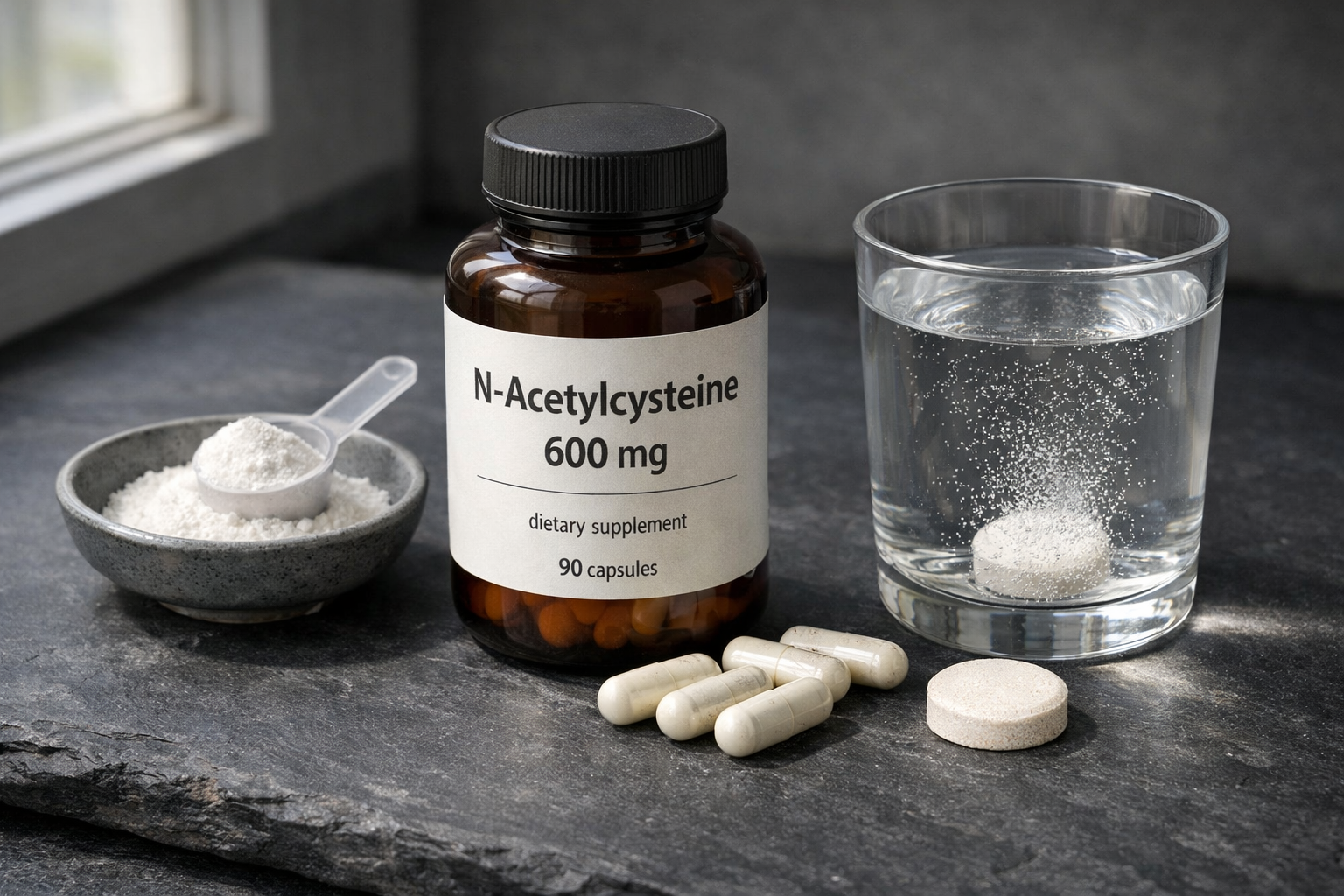
Product form matters in practice. Consumers usually encounter NAC as oral capsules, tablets, powders, or effervescent products, often in 500 mg or 600 mg strengths. Medical products include inhalation solutions, oral solutions, and IV acetylcysteine used in hospital care. Those formats are not interchangeable, because route affects both expected effect and safety. Inhaled acetylcysteine is intended to thin airway secretions, while IV acetylcysteine is used in acute poisoning. Consumers should not transfer hospital dosing logic to self-care supplementation. Sources: DailyMed — acetylcysteine inhalation and oral solution; DailyMed — acetylcysteine IV label
Respiratory research shows modest and inconsistent outcomes
NAC has long been studied in chronic bronchitis and COPD because of its mucus-related and antioxidant properties. The fairest reading is mixed rather than clearly positive or clearly negative. A Cochrane review of mucolytics as a class suggested a small reduction in exacerbations, and a 2017 NAC-specific meta-analysis suggested reduced exacerbation prevalence. However, that same 2017 analysis did not show meaningful improvements in lung-function measures such as FEV1, FVC, or inspiratory capacity, and it also did not show a clear benefit for exacerbation rate itself. Sources: Cochrane review on mucolytics; PubMed — 2017 COPD meta-analysis
More recent evidence has made the respiratory picture even more cautious. A 2023 meta-analysis found no significant benefit for several core respiratory outcomes, and a 2024 multicentre trial of 600 mg twice daily in mild-to-moderate COPD failed to significantly reduce annual exacerbation rate or improve lung function. This does not mean respiratory use is irrational, but it does mean claims should stay conservative. The evidence supports, at most, modest and inconsistent benefit in selected settings rather than a reliable lung-function supplement. Sources: PubMed — 2023 COPD meta-analysis; PubMed — 2024 multicentre COPD trial
PCOS looks promising, while psychiatric and addiction uses remain condition-specific
Among supplement-style uses, PCOS is one of the more coherent areas of research. A systematic review and meta-analysis pooling 11 randomized controlled trials in 869 women found that NAC may improve fasting glucose, fasting insulin, and some lipid markers. Many of the trials used oral NAC 600 mg three times daily over 6 to 24 weeks, and tolerability was generally acceptable. Even so, the authors emphasized limits such as short follow-up, small samples, and concentration of studies in a limited number of countries. That makes the results encouraging, but not definitive enough to treat NAC as standard care. Sources: Systematic review of NAC in PCOS
Psychiatric research is more heterogeneous. A meta-analysis of placebo-controlled trials found a modest improvement in depressive symptoms across several psychiatric conditions, suggesting possible adjunctive benefit over roughly 12 to 24 weeks. However, that does not make NAC a proven antidepressant, because the diagnoses and study designs varied. The strongest cautionary example is obsessive-compulsive disorder: a modern phase III placebo-controlled trial found no evidence that adjunctive NAC reduced symptoms. The best interpretation is not that psychiatric NAC is disproven across the board, but that results are mixed, adjunctive, and diagnosis-dependent. Sources: Journal of Clinical Psychiatry meta-analysis; PubMed — phase III OCD trial
Addiction-related research remains exploratory. A meta-analysis of randomized controlled trials reported signals of benefit in some substance-use outcomes, but the studies varied widely in substance type, treatment setting, dose, and outcome measurement. Dose ranges were broad, roughly 900 to 3,600 mg daily. That kind of heterogeneity makes it hard to translate the research into one practical consumer message beyond cautious optimism. It is fair to describe NAC as a possible adjunct under investigation in addiction care, but not as a proven anti-addiction supplement. Sources: Meta-analysis of NAC in substance-use disorders
Detox narratives, safety, and regulation shape real-world use
Some of the most popular NAC claims stretch beyond what the evidence supports. “Liver detox” is the clearest example: NAC is strongly established in acetaminophen poisoning, but that specific antidotal role should not be turned into a general cleansing claim for healthy people. A similar pattern appears in kidney-protection narratives around contrast exposure. After years of controversy, a mechanistic clinical paper noted that two large randomized trials showed no benefit, and its own work did not support the expected renal effect either. Biologically plausible mechanisms can still fail to deliver clinically meaningful results. Sources: StatPearls — Acetylcysteine; JAMA Network Open guidance on acetaminophen poisoning; PubMed — contrast nephropathy mechanistic paper
Adverse effects also depend heavily on route. Oral NAC is mainly limited by gastrointestinal intolerance, including nausea, vomiting, diarrhea, reflux, gas, and sulfur odor. Inhaled NAC can cause chest tightness, bronchoconstriction, and infrequent but clinically important bronchospasm, especially in people with asthma. IV NAC has its own pattern of rate-related hypersensitivity or anaphylactoid reactions, particularly during loading doses. This is why NAC can sound either very safe or very risky depending on which route a person is reading about. Sources: StatPearls — Acetylcysteine; DailyMed — acetylcysteine inhalation and oral solution; DailyMed — acetylcysteine IV label
Regulation adds another layer of complexity. In the United States, FDA says it intends to exercise enforcement discretion for certain NAC dietary supplements if they are otherwise lawful, but that does not give marketers permission to make disease claims. In the European Union, nutrition and health claims are tightly controlled, and country-level treatment of NAC can vary. The Netherlands offers a concrete example of caution: RIVM advised adults not to exceed 1,200 mg per day from supplements and warned against combining NAC supplements with NAC medicines. Quality tools such as the NIH label database, USP verification, or NSF certification may help with product selection, but they do not prove clinical benefit. Sources: FDA guidance on NAC supplements; FDA — structure-function claims; European Commission — nutrition and health claims; RIVM advice on NAC supplements; NIH Dietary Supplement Label Database; USP Verified Mark; NSF Certified for Sport
Regulatory Status (EU and US)
United States
NAC has an unusual regulatory history in the US because it was long marketed as a drug ingredient, raising a drug-exclusion question for dietary supplements. FDA's current position is that it intends to exercise enforcement discretion for certain NAC products labeled as dietary supplements if they are otherwise lawful. Supplement labels may use structure-function claims, but they cannot legally claim to treat, cure, or prevent diseases such as COPD, OCD, addiction, or liver disease. Sources: FDA guidance on NAC supplements; FDA — structure-function claims
European Union
In the EU, nutrition and health claims for foods and supplements are tightly controlled under the claims framework, and country-level treatment of NAC as a supplement versus a medicine can vary. The fact that a product is sold does not mean marketers can freely make broad disease claims. The Netherlands RIVM has also taken a cautious position, advising adults not to exceed 1,200 mg per day from supplements and warning against combining NAC supplements with NAC expectorant medicines. Sources: European Commission — nutrition and health claims; RIVM advice on NAC supplements
Dosage and Standardization
Studied oral doses: respiratory trials commonly used 600-1,200 mg/day, often 600 mg twice daily. PCOS trials often used 600 mg three times daily for 6-24 weeks. Psychiatric studies often used about 2,000 mg/day, with some OCD or psychosis trials around 2,400-2,700 mg/day. Addiction-related studies ranged about 900-3,600 mg/day. Prescription inhaled, oral-solution, and IV acetylcysteine protocols should not be converted into supplement directions.
Safety And Interactions
For oral NAC, the best documented side effects are gastrointestinal: nausea, vomiting, diarrhea, reflux, gas, and an unpleasant sulfur odor. Oral use is often described as generally well tolerated, but that does not mean side-effect free, especially as doses rise into the gram range. Sources: StatPearls — Acetylcysteine; DailyMed — acetylcysteine inhalation and oral solution
Route changes the safety profile. Inhaled NAC can cause chest tightness, bronchoconstriction, and bronchospasm, so people with asthma or reactive airways need caution. IV NAC has a separate pattern of rate-related hypersensitivity or anaphylactoid reactions, especially around the loading dose. These hospital-route risks are different from the typical experience with oral capsules. Sources: DailyMed — acetylcysteine inhalation and oral solution; DailyMed — acetylcysteine IV label; StatPearls — Acetylcysteine
The clearest repeatedly flagged interaction is with nitroglycerin, where NAC may enhance vasodilatory effects and contribute to headache or low blood pressure. Clinical references also note possible lowering of carbamazepine concentrations. NAC should not be casually combined with NAC-containing medicines, and extra caution is advised in breastfeeding, very young children, and people with significant medical conditions. Sources: StatPearls — Acetylcysteine; DailyMed — acetylcysteine inhalation and oral solution; RIVM advice on NAC supplements
Conclusion
NAC is best viewed as a cysteine-derived supplement and drug ingredient rather than a classical nutrient. Its strongest, most established benefits are medical: it is a standard antidote for acetaminophen overdose and an accepted mucolytic in selected clinical settings.
Outside those uses, the evidence becomes more mixed. Respiratory benefits appear modest and inconsistent, PCOS findings are promising but still limited, and psychiatric or addiction-related uses remain heterogeneous and condition-specific. Oral use is most often limited by gastrointestinal side effects, medication interactions need attention, and regulatory context matters because NAC occupies an unusual space between supplement and drug histories.
Disclaimer
Disclaimer: We attempt to do our best to find relevant, accurate and most up to date information available in both, the public domain and in the clinical and medical research community. We recommend reviewing scientific sources for official information on the subject. This post is not intended as medical advice. Each individual person's health conditions vary and we advise to consult a doctor before taking any supplements.