

 Deutsch
 Español
 Suomi
Suomi Français
 Bahasa Indonesia
 Italiano
 日本語
日本語 Português
 Tagalog
Summary
Glycine is a simple amino acid with broad biological importance. It helps build collagen and contributes to glutathione, creatine, heme, purines, and bile salts, so it is relevant to connective tissue, antioxidant defense, and general metabolism. Although the body can make glycine, the article notes that dietary supply may still matter when demand rises.
As a supplement, glycine is commonly sold as powder or capsules and is often marketed for sleep, recovery, collagen support, and metabolic health. The clearest human evidence is for modest sleep-related benefits, typically around 3 g before bed. Evidence for metabolic health, collagen support, exercise recovery, and other popular claims is more indirect, mixed, or still emerging, while short-term tolerance appears generally good.
Quick Facts
What is it useful for?
Glycine has its clearest human evidence for modest sleep-related benefits, especially at about 3 g before bedtime. Other uses are plausible or emerging but less established.
Supplement types
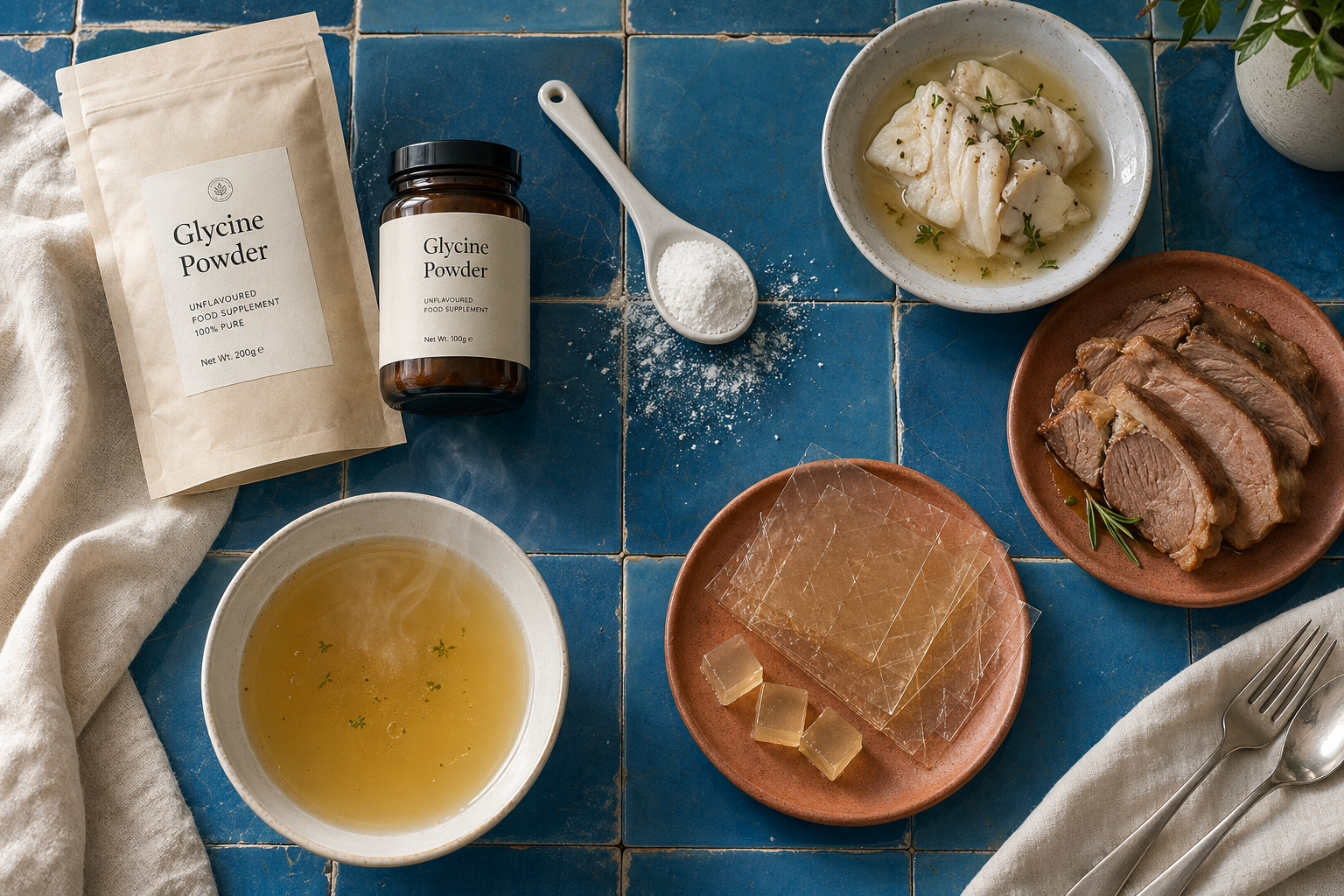
It is commonly sold as free-form powder or capsules. Glycine is also obtained through collagen, gelatin, and collagen hydrolysate products.
Interactions
A strong interaction map was not established in the supplied evidence. Combining glycine with medicines or other products should be individualized.
Side effects
Short-term use appears generally well tolerated. Mild digestive complaints are the most consistent practical side-effect signal.
Other possible benefits
Metabolic health, collagen support, body composition, and urinary symptoms are possible or emerging uses. The evidence for these is still limited.
Regulatory status
In the US, glycine can be sold as a dietary ingredient. In the EU, health claims require authorization and no glycine-specific approved claim was verified here.
What We Already Know About It
Core biology. Glycine is biologically important even though it is classified as nonessential. It is a precursor or structural component in collagen, glutathione, creatine, heme, purines, and bile salts, which makes it relevant to connective tissue, antioxidant defense, and general metabolism. Collagen-rich proteins are therefore meaningful dietary sources, and the fact that the body can synthesize glycine does not mean dietary intake is irrelevant in every circumstance. PMC review on glycine nutrition and metabolism Journal of Nutrition — glycine in late pregnancy
Conditional need. The usual “nonessential” label simply means endogenous synthesis is possible. The pregnancy study in the supplied sources suggests glycine may become conditionally indispensable in late gestation, especially when protein intake is modest, which supports a more nuanced view in which glycine status reflects both internal production and dietary supply. Journal of Nutrition — glycine in late pregnancy
Evidence pattern. Human outcome evidence is strongest for sleep, where small trials repeatedly used about 3 g before bed and reported better subjective sleep quality, lower morning fatigue, and some improvement in next-day performance. For metabolic health, collagen support, and exercise recovery, the biology is plausible but the direct outcome data remain limited, and higher plasma glycine does not automatically translate into better tissue synthesis or broader clinical benefit. Sleep and Biological Rhythms — bedtime glycine study Frontiers in Neurology — sleep restriction trial GeroScience systematic review on glycine in adults PubMed — collagen versus free amino acids mechanistic trial
Summary of Relevant Scientific Research
Broad Human Evidence Map — GeroScience systematic review
This review synthesized 52 human studies and found the clearest signal in nervous-system outcomes, especially sleep-related measures. It also emphasized that much of the evidence was short-term, heterogeneous, and at high risk of bias, so glycine appears promising rather than firmly established for broad wellness claims. GeroScience — The effect of glycine administration on the characteristics of physiological systems in human adults
Bedtime Glycine and Sleep Quality — Sleep and Biological Rhythms
In volunteers with sleep-quality complaints, 3 g before bed improved morning fatigue, liveliness, and clear-headedness. The trial closely matches common supplement use, but it was small and short, so the findings are suggestive rather than definitive. Sleep and Biological Rhythms — Subjective effects of glycine ingestion before bedtime on sleep quality
Next-Day Function After Sleep Restriction — Frontiers in Neurology
In 10 healthy men exposed to partial sleep restriction, 3 g of glycine before bedtime reduced next-day fatigue and improved some psychomotor vigilance measures. This supports a possible effect on next-day function, but the tiny male-only sample limits confidence. Frontiers in Neurology — The Effects of Glycine on Subjective Daytime Performance in Partially Sleep-Restricted Healthy Volunteers
When “Nonessential” May Not Be Enough — Journal of Nutrition
The pregnancy study concluded that glycine should be considered conditionally indispensable in late gestation, especially when protein intake is near the estimated average requirement. It supports careful wording on physiological demand, but it does not prove that routine supplementation is needed. Journal of Nutrition — Glycine, a Dispensable Amino Acid, Is Conditionally Indispensable in Late Stages of Human Pregnancy
Metabolic Interest Without Proven Efficacy — Obesity and metabolic disease review
Lower circulating glycine is consistently observed in obesity, type 2 diabetes, and fatty liver disease, which makes glycine biologically interesting. However, the review supports plausibility and biomarker value more than it proves that oral glycine reliably improves metabolic outcomes. PubMed — Glycine Metabolism and Its Alterations in Obesity and Metabolic Diseases
More Plasma Glycine Is Not the Same as More Repair — Collagen form studies
Collagen hydrolysate increased post-meal glycine exposure, but a separate acute mechanistic trial found that raising circulating amino acids through collagen hydrolysate or matched free amino acids did not further increase muscle or connective protein synthesis in healthy young adults. Nutrients — Enzymatic Hydrolysis of a Collagen Hydrolysate Enhances Postprandial Absorption Rate PubMed — Hydrolyzed collagen versus free amino acids on muscle connective protein synthesis
Beliefs, Myths & Unproven Claims
“Glycine is a proven insomnia treatment”
The supplied evidence supports glycine as a promising sleep aid, not a definitively proven therapy for insomnia. The sleep data mostly come from small, short-term studies using 3 g before bed and show modest improvements in subjective sleep quality and next-day fatigue. Sleep and Biological Rhythms — bedtime glycine study GeroScience systematic review on glycine in adults
“Glycine alone is proven to boost collagen production”
Glycine is abundant in collagen and collagen-rich products can raise plasma glycine, but the supplied evidence does not show that standalone glycine reliably improves skin, joint, tendon, or connective-tissue outcomes. Higher circulating glycine also did not automatically increase protein synthesis in acute mechanistic work. PMC review on glycine nutrition and metabolism Nutrients — collagen hydrolysate absorption study PubMed — hydrolyzed collagen versus free amino acids trial
“Low glycine automatically means supplementation will fix metabolic health”
Low circulating glycine is associated with obesity, type 2 diabetes, and fatty liver disease, but association does not prove that supplementation improves those conditions. The source set even includes an animal study in obesity that found worsened glucose tolerance after glycine supplementation, highlighting that the biology is more complex than simple deficiency logic. PubMed — glycine metabolism in obesity and metabolic diseases PubMed — obesity animal study on glycine and glucose intolerance
“Nonessential means intake does not matter”
In nutrition science, nonessential means the body can synthesize the amino acid; it does not mean intake is irrelevant or that supply always meets demand. The late-pregnancy evidence in the source set is a clear example of why glycine may be better described as usually nonessential but potentially conditionally indispensable in some physiological states. Journal of Nutrition — glycine in late pregnancy
Detailed Research Observations
Biological Role and Nutrient Context
Glycine is one of the simplest amino acids structurally, but it occupies a central place in human metabolism. In the supplied literature it appears not as a fringe wellness ingredient, but as a precursor or structural component in collagen, elastin, glutathione, heme, purines, creatine, sarcosine, and bile salts. That matters because it links glycine to connective tissue, antioxidant defense, and basic cellular function rather than to one narrowly defined supplement effect. The open-access review in the source set also argues that dietary glycine can become rate-limiting for glutathione synthesis in some circumstances, which helps explain why a “nonessential” amino acid can still have meaningful nutritional relevance. PMC review on glycine nutrition and metabolism
This broad biological role also helps explain why glycine is marketed for many different goals. The article’s overall conclusion, however, is that biochemical importance does not automatically equal proven clinical efficacy for every advertised use. Glycine is clearly important in the body, but the strength of direct human outcome evidence varies sharply depending on the claim being made. GeroScience systematic review on glycine in adults
Endogenous Synthesis Versus Dietary Need
A key nuance in the source article is that glycine is usually described as nonessential because the body can synthesize it, but that label does not answer whether synthesis is always enough. The late-pregnancy study included in the source set found biochemical signs consistent with lower glycine availability when intake was lower, and the authors concluded that glycine should be considered conditionally indispensable in late gestation, especially when protein intake is around the current estimated average requirement. This does not automatically justify routine supplementation in pregnancy, but it clearly challenges the simplistic idea that endogenous production always covers demand. Journal of Nutrition — Glycine, a Dispensable Amino Acid, Is Conditionally Indispensable in Late Stages of Human Pregnancy
For general readers, the practical implication is that glycine status depends on both what the body makes and what the diet provides. The article uses this point to frame glycine as a nutrient whose importance can become more visible during higher-demand states such as pregnancy, illness, aging, or low intake of collagen-rich foods. PMC review on glycine nutrition and metabolism
Food Sources, Forms, and Bioavailability
The supplied literature does not treat glycine as a classic vitamin with one clear intake target. Instead, it emphasizes source and matrix. Glycine is especially abundant in collagen-rich materials, so practical food sources are better thought of as gelatinous cuts, connective tissue, skin, broth, gelatin, and collagen-rich proteins rather than ordinary high-protein foods in general. Human feeding data cited in the article also show that collagen proteins and dairy proteins produce different post-meal amino-acid patterns: collagen gives higher glycine peaks, while dairy gives higher leucine peaks. PMC review on glycine nutrition and metabolism PubMed — postprandial amino-acid patterns with collagen and dairy proteins
For supplements, the article treats most standalone glycine products as practical variations rather than radically different biologically active forms. Plain glycine powder and capsules mainly differ in convenience, taste, and dose flexibility. Larger distinctions appear when comparing free glycine with collagen hydrolysate or gelatin, because collagen-based products change the surrounding amino-acid matrix and the absorption profile. Human data show collagen hydrolysate can efficiently raise plasma glycine, and enzymatic hydrolysis can increase the speed of that rise, but the article stresses that kinetic differences should not be overinterpreted as proof of superior clinical outcomes. FDA — Questions and Answers on Dietary Supplements USP–NF Glycine monograph Nutrients — collagen hydrolysate absorption study
Sleep Is the Clearest Consumer Use-Case
Among common supplement claims, sleep has the best direct human support in the supplied evidence. Small trials repeatedly used about 3 g before bedtime and reported better subjective sleep quality, improved morning alertness, and reduced fatigue. In one sleep-restriction experiment, glycine also improved some next-day psychomotor vigilance measures, which adds practical relevance because the effect was not limited to bedtime perception alone. Sleep and Biological Rhythms — bedtime glycine study Frontiers in Neurology — sleep restriction trial
At the same time, the article repeatedly warns against overstating this evidence. The GeroScience review found the nervous system signal to be the clearest area in the literature, but it also characterized much of the evidence base as small, short-term, heterogeneous, and at risk of bias. The article’s interpretation is therefore cautious: glycine is best described as a promising sleep aid with modest data, not as a proven insomnia treatment or a drug-like sedative. GeroScience — The effect of glycine administration on the characteristics of physiological systems in human adults J-GLOBAL entry on glycine sleep findings
Metabolic Health Signals Are Plausible but Unsettled
Glycine frequently appears in metabolic research because lower circulating levels are consistently observed in obesity, type 2 diabetes, and nonalcoholic fatty liver disease. This makes glycine an interesting biomarker and a biologically plausible therapeutic target, especially given its connection to glutathione metabolism and one-carbon pathways. However, the article is clear that association is not efficacy: the cited review supports plausibility, not a proven consumer-facing benefit from oral glycine supplementation in healthy adults or patients. PubMed — Glycine Metabolism and Its Alterations in Obesity and Metabolic Diseases
The article adds an important caution from preclinical work. In an obesity animal model, glycine supplementation worsened glucose tolerance through enhanced liver gluconeogenesis. Animal data do not determine human outcomes, but the result is useful because it undermines the simplistic argument that “low blood glycine” automatically means supplementation will help. The author uses this example to show that glycine biology is more complex than some marketing claims suggest. PubMed — obesity animal study on glycine and glucose intolerance
Collagen Support and Exercise Recovery Need Restraint
Because collagen is rich in glycine, supplement marketing often moves quickly from biochemical relevance to claims about skin, joints, tendons, recovery, or “collagen production.” The article agrees that the rationale is real: collagen-based products can raise plasma glycine and alter postprandial amino-acid patterns. But it also emphasizes that direct outcome data for standalone glycine on skin, joint, or tendon endpoints were sparse in the supplied evidence set, so the leap from mechanism to proven benefit is not justified. PMC review on glycine nutrition and metabolism Nutrients — collagen hydrolysate absorption study
The acute mechanistic trial comparing hydrolyzed collagen with matched free amino acids is especially informative. Both interventions substantially increased circulating amino acids, especially glycine, yet neither further increased myofibrillar or muscle connective protein synthesis rates in healthy young adults under the tested conditions. The article does not present this as proof that longer-term benefits are impossible, but it uses the finding to challenge the idea that a larger rise in blood glycine automatically means better repair or better recovery. PubMed — Hydrolyzed collagen versus free amino acids on muscle connective protein synthesis
Specialized Clinical Signals, Regulation, and Remaining Gaps
Outside sleep, the evidence set includes some real but context-specific human findings. A urology outpatient study reported improved urine storage symptoms with 3 g twice daily, while studies in malnourished hemodialysis patients and critically ill patients showed that glycine can raise tissue exposure and may influence fat-free mass or muscle-related outcomes in specialized settings. The article treats these findings as interesting signals, but not as evidence that healthy adults should expect the same results from routine supplementation. PubMed — urology study on urine storage symptoms PubMed — hemodialysis crossover trial PubMed — enteral glycine in critically ill patients
The regulatory picture is also more cautious than some marketing language implies. In the United States, glycine fits within the dietary supplement framework for amino acids and also appears in FDA’s food-substance inventory, while in the European Union health claims must be formally authorized and the source set did not verify a glycine-specific approved claim. The article finishes by noting key gaps: small and heterogeneous trials, limited long-term data, no identified tolerable upper intake level for supplemental glycine, and a sparse interaction map. These uncertainties matter when translating biochemical importance into public advice. FDA — Questions and Answers on Dietary Supplements FDA Food Substance Inventory — Glycine European Commission — Nutrition and health claims EU Register of nutrition and health claims National Academies — amino acid safety review
Regulatory Status (EU and US)
United States
In the US, glycine fits the FDA and DSHEA framework for amino acids as dietary ingredients, so it can be sold in standard supplement forms such as powders and capsules. FDA's food-substance inventory also lists glycine as a substance added to food, which reinforces that glycine has both a supplement and conventional food-use context. This regulatory status permits sale in these categories, but it does not by itself validate efficacy claims. FDA — Questions and Answers on Dietary Supplements FDA Food Substance Inventory — Glycine
European Union
In the EU, the key issue is health-claim authorization. Foods and supplements may be sold, but health claims must be scientifically substantiated and formally authorized in the public register. The supplied source set did not verify a glycine-specific authorized health claim, so marketers should not imply an EFSA-approved sleep, collagen, or metabolic benefit unless a specific authorized entry is separately confirmed. European Commission — Nutrition and health claims EU Register of nutrition and health claims
Quality standards. The article also notes the USP glycine monograph as a useful quality benchmark, suggesting that differences between products are more likely to involve identity, purity, and dosing accuracy than exotic proprietary forms. USP–NF Glycine monograph
Dosage and Standardization
Most studied pattern: 3 g shortly before bedtime is the cleanest consumer-facing dose in the reviewed human literature and the main amount used in sleep-focused studies.
Other study settings: 3 g twice daily was used for urinary symptoms, 7 g twice daily in a hemodialysis crossover trial, and roughly 16–30 g/day enterally in critical illness. These higher intakes came from specialized or medical settings and should not be casually transferred to general wellness use. Free glycine powder is the simplest way to measure a precise dose, while capsules may require multiple units. No dedicated RDA or tolerable upper intake level for glycine in healthy adults was identified in the supplied official materials.
Safety And Interactions
Short-term tolerance. Short-term glycine supplementation appears generally well tolerated in the supplied human literature. The clearest side-effect signal is mild digestive discomfort, especially at higher acute intakes, and one small acute study found that 9 g did not produce serious adverse events or next-day sleepiness carry-over. J-STAGE — acute safety study of glycine ingestion
Limits of the safety data. No formal tolerable upper intake level for supplemental glycine was identified in the supplied official materials. The amino-acid safety review cited in the article also noted that the literature does not yet support clear upper limits for supplemental amino acids beyond protein-associated intakes, so long-term high-dose safety remains uncertain. National Academies — amino acid safety review
Interactions and caution groups. The retrieved source set did not establish a robust medication-interaction map, so detailed interaction claims would be speculative. Pregnancy, breastfeeding, chronic disease, and prescription medicine use are situations where individualized medical advice is especially appropriate. Journal of Nutrition — glycine in late pregnancy National Academies — amino acid safety review
Conclusion
Glycine is a nutritionally and biologically important amino acid because it sits at the center of collagen structure and several major metabolic pathways. The body can synthesize it, yet dietary supply can still matter when demand rises or collagen-rich foods are low. For general readers, the most evidence-supported use of glycine as a supplement is sleep-related support, where small human studies repeatedly used 3 g before bed and found modest improvements in subjective sleep quality and next-day fatigue.
For metabolic health, collagen support, and exercise recovery, the evidence is still weaker. Food sources, collagen products, and free glycine supplements differ mainly in dose precision and amino-acid context, not in any clearly proven hierarchy of benefit. Short-term safety appears fairly good, but the absence of a formal upper limit and the lack of robust long-term data argue for moderation. Overall, glycine has moderate evidence for sleep and preliminary evidence for many other popular uses.
Disclaimer
Disclaimer: We attempt to do our best to find relevant, accurate and most up to date information available in both, the public domain and in the clinical and medical research community. We recommend reviewing scientific sources for official information on the subject. This post is not intended as medical advice. Each individual person's health conditions vary and we advise to consult a doctor before taking any supplements.