

 Deutsch
 Español
 Suomi
Suomi Français
 Bahasa Indonesia
 Italiano
 日本語
日本語 Português
 Tagalog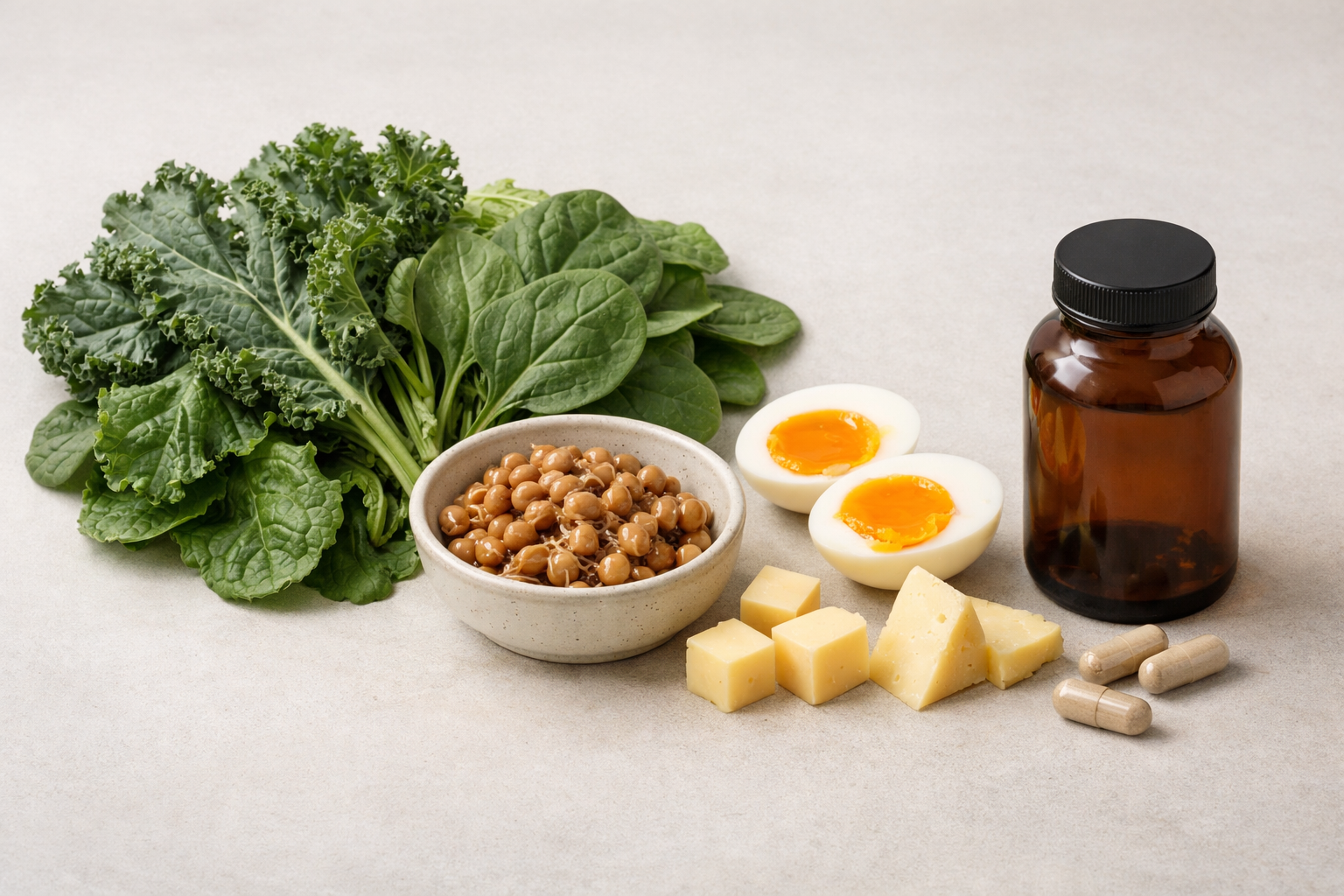
Summary
Vitamin K is a family of fat-soluble nutrients that supports normal blood clotting and normal bone physiology. K1, or phylloquinone, is the main dietary form, while K2 refers to menaquinones such as MK-4 and MK-7, found in some animal foods and fermented foods.
The strongest evidence supports vitamin K as an essential nutrient for coagulation, with good support for its role in bone biology. K2, especially MK-7, often improves vitamin K-related biomarkers more consistently than it proves major outcomes such as fewer fractures, less vascular calcification, or fewer cardiovascular events.
Quick Facts
What is it useful for?
Vitamin K is essential for normal blood clotting and supports normal bone physiology. K2 is mainly studied for improving vitamin K-related biomarkers.
Supplement types
Supplements usually contain K1 (phylloquinone) or K2 menaquinones, especially MK-4 and MK-7. These forms differ in half-life and typical study doses.
Interactions
The clearest clinically important interaction is with warfarin-type anticoagulants. Orlistat, bile-acid sequestrants, and prolonged antibiotic use can also affect vitamin K status or absorption.
Side effects
Natural vitamin K has very low oral toxicity. Adverse effects from food or typical supplements have not been identified in healthy adults.
Other possible benefits
K2 may improve osteocalcin and dp-ucMGP biomarkers, but evidence for major fracture or cardiovascular-event reduction remains incomplete.
Regulatory status
In the EU, vitamin K claims are allowed for normal clotting and bones, but not for heart and blood vessel function. In the U.S., supplements are sold without FDA pre-approval for efficacy.
What We Already Know About It
Core mechanism. Vitamin K acts as a cofactor that enables the activation, or gamma-carboxylation, of certain proteins through the vitamin K cycle. This is essential for clotting factors made in the liver, which is why vitamin K’s role in normal blood coagulation is one of the firmest conclusions in nutrition science. The same system also affects extrahepatic proteins such as osteocalcin in bone and matrix Gla protein in vascular tissues.
Established functions. The best-supported conclusions are that vitamin K is necessary for normal coagulation and contributes to normal bone physiology. Adult deficiency severe enough to cause clinical problems is uncommon because the body recycles vitamin K efficiently, although its stores are limited. Risk becomes more relevant in newborns, people with fat-malabsorption disorders, and those using medications that impair absorption or antagonize vitamin K metabolism.
Where uncertainty begins. Supplementation evidence is less definitive than the underlying biology. K2, especially MK-7, often improves biomarkers such as undercarboxylated osteocalcin and dp-ucMGP more consistently than K1 at modest doses, partly because it stays in circulation longer. But biomarker improvement is not the same as proven fracture prevention or cardiovascular-event reduction, so extra-benefit claims remain more tentative than vitamin K’s established nutritional role.
Summary of Relevant Scientific Research
High-level vitamin K overview — NIH Office of Dietary Supplements and Linus Pauling Institute
These institutional reviews describe vitamin K as a family of fat-soluble compounds with limited body stores, variable absorption, and a central role in the vitamin K cycle. They present coagulation as the clearest established function, while bone and cardiovascular supplementation evidence remains mixed rather than definitive. NIH ODS — Vitamin K Fact Sheet; Linus Pauling Institute — Vitamin K
Why MK-7 gets attention — Schurgers et al. and Nieman et al.
Human pharmacokinetic work found that MK-7 remains in circulation longer than vitamin K1 and produces more stable blood levels. Another study reported similar bioavailability and biological activity for synthetic all-trans MK-7 and fermentation-derived MK-7, supporting the idea that product quality and configuration matter more than source marketing. PubMed — Schurgers et al. 2007 on MK-7 pharmacokinetics; PubMed — Nieman et al. 2016 on MK-7 bioavailability
Bone trials and meta-analyses — Knapen et al., Guo et al., Huang et al., 2024 meta-analysis
Long-term studies in postmenopausal women showed that MK-7 can improve vitamin K status markers and, in some settings, slow age-related decline in bone measures. But other trials found strong biomarker improvement without clear benefits for areal BMD or bone microarchitecture, and meta-analyses note that fracture and BMD findings weaken when higher-quality trials are emphasized. PubMed — Knapen et al. 2013; PubMed — 3-year MK-7 osteopenia trial; PubMed — Guo et al. 2019 meta-analysis; PubMed — Huang et al. 2022 review; PubMed — 2024 vitamin K meta-analysis
Cardiovascular evidence remains unsettled — Knapen et al., Shea et al., Zwakenberg et al., later reviews
Some trials found that MK-7 lowered dp-ucMGP and improved arterial stiffness measures, and phylloquinone showed a possible adherence-dependent signal for less coronary calcification progression. However, randomized studies in higher-risk groups have also been neutral, and reviews conclude that evidence for preventing cardiovascular disease or vascular calcification is still heterogeneous and insufficient for firm recommendations. PubMed — Knapen et al. 2015 arterial stiffness trial; PMC — Shea et al. coronary artery calcification study; PubMed — Zwakenberg et al. 2019; PubMed — Genep et al. 2022; PubMed — cardiovascular meta-analysis
Safety is reassuring outside anticoagulant use — NIH, USP review, hemostatic study
Safety reviews report low toxicity from natural vitamin K and no identified tolerable upper intake level for food or supplements. The major practical issue is interference with warfarin-type anticoagulants, while a study in elderly osteoporosis patients did not find hemostatic overactivation from vitamin K administration in that setting. NIH ODS — Vitamin K Fact Sheet; PubMed — MK-7 safety evaluation; PubMed — hemostatic study in osteoporosis patients; Mayo Clinic — Warfarin and vitamin K guidance
Beliefs, Myths & Unproven Claims
K2 moves calcium out of arteries and into bones
This popular slogan compresses a real mechanism into a claim that sounds more proven than it is. Vitamin K does help activate osteocalcin and matrix Gla protein, but randomized trials on fractures, coronary calcification, and cardiovascular events have produced mixed results rather than a universal clinical benefit. Linus Pauling Institute — Vitamin K; PubMed — vitamin K and vascular calcification review; PubMed — cardiovascular evidence review
K1 is only for clotting, K2 is only for bones and arteries
Both forms participate in the same vitamin K cycle and support vitamin K-dependent proteins. The practical differences relate more to food sources, circulation time, tissue distribution, and the kinds of studies performed than to a strict biological separation of roles. NIH ODS — Vitamin K Fact Sheet; Linus Pauling Institute — Vitamin K; PubMed — Schurgers et al. 2007
Everyone taking vitamin D should automatically add K2
Combined vitamin D and K studies are biologically interesting and some improve bone-related markers or total BMD, but the evidence does not support a blanket rule for all adults. The stronger findings are still context-dependent and often rely on biomarkers or selected populations rather than hard outcomes in the general population. RSC Food & Function — vitamin D and K meta-analysis; PubMed — Guo et al. 2019 meta-analysis
Vitamin K supplements cause dangerous clotting in healthy people
The evidence does not show harmful hemostatic overactivation from nutritional or commonly supplemented doses in healthy users. The real concern is interaction with vitamin K antagonists such as warfarin, where changes in intake can interfere with treatment. PubMed — hemostatic study in osteoporosis patients; NIH ODS — Vitamin K Fact Sheet; Mayo Clinic — Warfarin and vitamin K guidance

Detailed Research Observations
Vitamin K is a family of compounds, not one substance
Vitamin K includes several related fat-soluble compounds rather than a single molecule. The main dietary form is vitamin K1, or phylloquinone, which is concentrated in leafy green vegetables and some plant oils. Vitamin K2 refers to menaquinones with different side-chain lengths, including MK-4 and MK-7. MK-4 is present in some animal foods and can also be formed in the body from phylloquinone, while MK-7 is especially associated with fermented foods such as natto. This distinction matters because discussions of “vitamin K” and “vitamin K2” often mix together nutrients with different food patterns, pharmacokinetics, and research traditions. NIH ODS — Vitamin K Fact Sheet; Linus Pauling Institute — Vitamin K
Absorption and practical intake are also more nuanced than many supplement summaries suggest. Because vitamin K is fat-soluble, absorption improves when consumed with dietary fat. Food matrix matters as well: phylloquinone embedded in leafy greens is less bioavailable than free or oil-based forms. Vitamin K circulates mainly in lipoproteins, is metabolized relatively quickly, and body stores are limited, which helps explain why regular intake matters even though overt adult deficiency is uncommon under normal conditions. NIH ODS — Vitamin K Fact Sheet; Linus Pauling Institute — Vitamin K
Why MK-7 stands out in supplement discussions
MK-7 receives disproportionate attention because human pharmacokinetic studies show that it remains in circulation longer than vitamin K1 and produces more stable blood levels. That longer half-life likely helps it reach extrahepatic vitamin K-dependent proteins such as osteocalcin and matrix Gla protein at relatively modest daily doses. This is why MK-7 so often appears in marketing for bone and vascular health, and it is also why trials using nutritional-dose MK-7 frequently show strong biomarker responses. PubMed — Schurgers et al. 2007 on MK-7 pharmacokinetics; PubMed — 2024 vitamin K meta-analysis
Even so, the mechanistic advantage should not be overstated. A longer half-life and better biomarker response do not automatically prove superior long-term clinical outcomes. Research also suggests that synthetic all-trans MK-7 and fermentation-derived MK-7 can show similar bioavailability and biological activity, which means the source story is less important than factors such as the form used, product stability, all-trans content, and the claims being made for the product. PubMed — Nieman et al. 2016 on MK-7 bioavailability; PubMed — 2024 vitamin K meta-analysis
Bone biology is real, but supplementation outcomes are mixed
Vitamin K contributes to normal bone physiology through vitamin K-dependent proteins such as osteocalcin, and this role is recognized by both scientific and regulatory bodies. The uncertainty begins when the question shifts from physiology to supplementation outcomes. In a notable 3-year trial, 180 µg/day of MK-7 improved vitamin K status and was associated with less age-related decline in bone mineral density and bone strength indices in healthy postmenopausal women. That kind of result supports the idea that K2 is biologically relevant for bone health. PubMed — Knapen et al. 2013
But the broader literature does not deliver one clear conclusion. Another 3-year trial using 375 µg/day MK-7 with calcium and vitamin D in women with osteopenia strongly improved undercarboxylated osteocalcin without significantly changing areal BMD loss or long-term bone microarchitecture. Meta-analyses report possible benefits in postmenopausal or osteoporotic groups, yet they also emphasize heterogeneity and the strong influence of older Japanese MK-4 studies that used pharmacologic doses not comparable with common over-the-counter MK-7 products. The recurring theme is that biochemical effects are more consistent than fracture or BMD effects. PubMed — 3-year MK-7 osteopenia trial; PubMed — Guo et al. 2019 meta-analysis; PubMed — Huang et al. 2022 review; PubMed — 2024 vitamin K meta-analysis
Cardiovascular claims are plausible, interesting, and still unsettled
Vitamin K’s cardiovascular appeal comes from a genuine biological mechanism. Matrix Gla protein is involved in calcification control, and observational work has linked higher vitamin K status or menaquinone intake with lower cardiovascular risk in some populations. Some randomized trials have also reported encouraging intermediate findings, including reduced dp-ucMGP and improved arterial stiffness measures with MK-7. These results help explain why K2 is often marketed for arterial health. PubMed — Knapen et al. 2015 arterial stiffness trial; PubMed — review of vitamin K and cardiovascular health
The problem is that hard clinical or imaging outcomes have not been consistently improved. Phylloquinone plus calcium and vitamin D showed a possible adherence-dependent signal for less coronary calcification progression, but other randomized studies in people with type 2 diabetes and established cardiovascular disease and in elderly men with aortic valve calcification were neutral. Reviews and meta-analyses therefore describe the evidence as heterogeneous and insufficient for firm clinical recommendations. This is a clear example of why mechanistic plausibility and biomarker improvement should not be treated as settled proof of prevention. PMC — Shea et al. coronary artery calcification study; PubMed — Zwakenberg et al. 2019 trial; PubMed — Genep et al. 2022 trial; PubMed — vascular calcification review; PubMed — cardiovascular meta-analysis
Deficiency risk, dose context, and product claims all matter
Clinically meaningful adult deficiency is uncommon, but it becomes more plausible in newborns, people with fat-malabsorption disorders, cholestatic disease, cystic fibrosis, celiac disease, bariatric surgery, and in those using drugs that impair vitamin K absorption or recycling. Chronic kidney disease and dialysis populations often show abnormal dp-ucMGP, suggesting functional insufficiency, yet supplementation in these groups has not consistently translated into better vascular outcomes. Again, vitamin K research often shows a measurable biological target without a corresponding proven clinical benefit. CDC — Vitamin K Deficiency Bleeding; NIH ODS — Vitamin K Fact Sheet; PubMed — CKD vitamin K review; PubMed — dialysis and vitamin K trial evidence
Dose comparisons add another layer of confusion. US adequate intake targets are 120 µg/day for men and 90 µg/day for women, while EFSA uses 70 µg/day for adults, but these figures are based mainly on coagulation adequacy and do not define an optimal K2 intake for bone or vascular outcomes. Trial doses vary widely: MK-7 is often studied at 180 to 375 µg/day, phylloquinone at 500 µg/day to 1 mg/day, and MK-4 at 45 mg/day in Japanese osteoporosis studies. These interventions are not interchangeable, and legal supplement status in the EU or US does not mean a marketed cardiovascular claim is clinically proven. EFSA — Dietary Reference Values for vitamin K; PMC — phylloquinone vascular trial; PubMed — MK-7 bone trial; PubMed — review of MK-4 osteoporosis evidence; FDA — Information for consumers using dietary supplements; EU Register — permitted nutrition and health claims
Regulatory Status (EU and US)
European Union
The EU Register allows claims that vitamin K contributes to normal blood clotting and to the maintenance of normal bones when product composition meets the required conditions. EFSA did not substantiate a vitamin K2 claim for normal heart and blood vessel function, and EFSA’s dietary reference work retained a general adult adequate intake of 70 µg/day without setting separate requirements for specific K2 forms.
Natto-derived vitamin K2 has been authorized as a novel food ingredient in Europe, and some menaquinone sources are permitted in fortification rules. But ingredient legality is not the same as proven efficacy for disease-related outcomes.
United States
In the U.S., vitamin K and K2 can be sold as dietary supplements under DSHEA, but the FDA does not pre-approve supplements for efficacy before marketing. The NIH Office of Dietary Supplements also notes that FDA has not authorized a health claim for vitamin K, so products may be sold without broad disease-prevention claims being officially validated.
Dosage and Standardization
Adequacy targets. In the United States, adequate intake is 120 µg/day for men and 90 µg/day for women. EFSA sets 70 µg/day for adults, including pregnancy and lactation. These targets are based mainly on coagulation adequacy and do not establish an optimal K2 intake for bone or vascular outcomes.
Studied supplemental doses. Phylloquinone has been studied at 500 µg/day in vascular trials and 1 mg/day in some bone studies. MK-7 is commonly studied at about 180 to 375 µg/day for bone outcomes and 360 µg/day in some calcification-related trials. MK-4 has often been used at 45 mg/day in Japanese osteoporosis studies. Taking vitamin K with a meal containing fat can improve absorption.
Safety And Interactions
General safety. For most healthy adults, vitamin K from food or supplements appears to have a strong safety profile. No tolerable upper intake level was set for natural vitamin K because adverse effects from foods or supplements had not been identified, and a published MK-7 safety evaluation did not identify serious oral safety concerns in the reviewed data.
Main interaction. The most important interaction is with vitamin K antagonist anticoagulants such as warfarin, phenprocoumon, and acenocoumarol. The practical advice is consistency rather than total avoidance, because sudden changes in intake from food or supplements can destabilize anticoagulation.
Other concerns. Bile-acid sequestrants and orlistat can reduce vitamin K absorption, and prolonged antibiotic use can worsen vitamin K status in some people. Risk matters more in people with malabsorption disorders, liver or biliary disease, cystic fibrosis, celiac disease, bariatric surgery, or chronic kidney disease. Vitamin K is relevant to warfarin reversal, but it is not the antidote for most direct oral anticoagulants.
Conclusion
Vitamin K is an essential nutrient with a very strong evidence base for supporting normal blood clotting, and its role in normal bone physiology is also well supported. The distinction between K1 and K2 matters mainly in food sources, pharmacokinetics, tissue distribution, and the kinds of studies available. MK-7 stands out because it has a longer half-life and consistently improves vitamin K-related biomarkers at relatively modest doses.
Where caution is needed is in moving from biochemical plausibility to clinical certainty. K2 evidence is stronger for improving markers such as undercarboxylated osteocalcin and dp-ucMGP than for proving major reductions in fractures, calcification, heart attacks, or strokes. A balanced conclusion is that regular vitamin K intake is sensible, K2 is scientifically interesting, and current evidence does not justify sweeping claims that all adults need K2 supplements for bone or cardiovascular protection.
Disclaimer
Disclaimer: We attempt to do our best to find relevant, accurate and most up to date information available in both, the public domain and in the clinical and medical research community. We recommend reviewing scientific sources for official information on the subject. This post is not intended as medical advice. Each individual person's health conditions vary and we advise to consult a doctor before taking any supplements.