

 Deutsch
 Español
 Suomi
Suomi Français
 Bahasa Indonesia
 Italiano
 日本語
日本語 Português
 Tagalog
Summary
Riboflavin, or vitamin B2, is an essential water-soluble vitamin needed to form FMN and FAD, coenzymes involved in energy production, oxidation-reduction reactions, and the metabolism of nutrients such as vitamin B6 and niacin. For most people, supplementation matters mainly for preventing or correcting low intake or deficiency.
Beyond basic nutrition, the best-supported higher-dose use is adult migraine prevention. Evidence suggests 400 mg/day may reduce migraine frequency in some adults, but benefits are usually modest and not proven for everyone. Claims for universal energy boosting, superior “active” forms, or broad blood-pressure benefits are less well established.
Quick Facts
What is it useful for?
Riboflavin is mainly useful for preventing or correcting deficiency. Higher-dose use has the best support for adult migraine prevention.
Supplement types
Common forms are free riboflavin and riboflavin-5′-phosphate. Current oral evidence does not show a clear everyday advantage for the phosphate form.
Interactions
Riboflavin works alongside other B vitamins in metabolism. No clinically relevant medication interactions are known.
Side effects
Riboflavin is usually well tolerated. Bright yellow or yellow-orange urine is the most common harmless effect at higher doses.
Other possible benefits
Research is exploring genotype-specific blood-pressure effects in people with MTHFR 677TT. This is not a general-use claim for the wider population.
Regulatory status
In the US, riboflavin is sold as a dietary supplement with structure/function claim limits. In the EU, normal-function claims are allowed, but migraine claims are not standard authorized nutrient claims.
What We Already Know About It
Core physiology. Riboflavin is vitamin B2 and the precursor of FMN and FAD, coenzymes required for energy-yielding metabolism, oxidation-reduction reactions, and the handling of fats, steroids, some drugs, vitamin B6, niacin, and homocysteine-related pathways. Because these functions are fundamental, riboflavin status also supports normal growth, red blood cells, and nervous system function, while deficiency can affect the mouth, skin, eyes, and blood. NIH ODS — Riboflavin Fact Sheet; EFSA review on riboflavin absorption and requirements
Absorption and dosing. Most dietary riboflavin reaches the intestine as FMN or FAD bound to food proteins, then is hydrolyzed to free riboflavin before absorption. Uptake in the proximal small intestine is carrier-mediated and saturable, so absorption does not keep rising proportionally at very high oral doses. This helps explain why a small nutritional top-up and a 100 to 400 mg migraine protocol are not equivalent uses. NIH ODS — Riboflavin Fact Sheet; EFSA review on riboflavin absorption and requirements
Best-supported clinical use. Beyond deficiency prevention, the most credible supplemental use is adult migraine prevention. Guideline bodies and meta-analyses suggest that 400 mg/day can reduce migraine frequency in some adults, although effects are usually modest rather than dramatic. Broader claims, such as universal energy enhancement, clearly superior activated forms, or routine blood-pressure lowering for everyone, remain less established. AAN/AHS migraine prevention guideline; Systematic review of riboflavin monotherapy for migraine; 2025 review of riboflavin and blood pressure
Summary of Relevant Scientific Research
Core riboflavin physiology — NIH Office of Dietary Supplements
NIH’s professional review describes riboflavin as the precursor of FMN and FAD, explains its role in energy production and nutrient metabolism, notes generally high food bioavailability at usual intakes, and reports that large single doses are absorbed less efficiently. It also summarizes recognizable deficiency patterns and supportive evidence for adult migraine prevention at 400 mg/day. NIH ODS — Riboflavin Fact Sheet
Reference intakes and absorption limits — EFSA
EFSA set adult reference intakes at 1.6 mg/day, with higher values in pregnancy and lactation, and explained that food-bound FMN and FAD are hydrolyzed before carrier-mediated absorption in the proximal small intestine. The opinion also highlights saturable uptake, meaning absorbed amounts do not keep increasing proportionally at very high oral doses. EFSA — Riboflavin dietary reference values; EFSA review on riboflavin absorption and requirements
Adult migraine prevention — AAN/AHS guideline
The American Academy of Neurology and American Headache Society guideline classifies riboflavin as probably effective for episodic migraine prevention in adults. This places it among the better-supported nonprescription options, while still signaling that the evidence is helpful rather than definitive. AAN/AHS migraine prevention guideline
Meta-analytic support for migraine — Recent reviews
A systematic review of riboflavin monotherapy and a broader randomized-trial meta-analysis both found a generally favorable signal for reduced migraine attack frequency, with more mixed results for severity and duration. These reviews strengthen the case that the migraine effect is reproducible, but they also note limited trial numbers and methodological variability. Systematic review of riboflavin monotherapy for migraine; Meta-analysis of dietary supplements for migraine prophylaxis
Blood pressure and genotype — MTHFR-focused research
Targeted studies suggest riboflavin may improve blood-pressure control in treated hypertensive adults with the MTHFR 677TT genotype, but a broader 2025 review judged the overall blood-pressure evidence in adults to be very uncertain. This supports a possible personalized-nutrition role, not a general claim for the public. Randomized trial in MTHFR 677TT hypertension; BMC Medicine — JINGO MTHFR riboflavin review; 2025 review of riboflavin and blood pressure
Beliefs, Myths & Unproven Claims
Extra riboflavin boosts energy for everyone
Riboflavin is essential for normal energy metabolism, so correcting a deficiency can help when low status is part of the problem. That does not mean high-dose riboflavin gives an extra energy boost to people who already meet their needs; the evidence supports normal function and deficiency prevention, not universal energy enhancement. NIH ODS — Riboflavin Fact Sheet; EU Register — authorized riboflavin claims
Riboflavin-5′-phosphate is always superior
The phosphate form is often marketed as an “active” version, but oral physiology weakens the claim that it is inherently better for routine use. EFSA reports that riboflavin-5′-phosphate sodium is rapidly dephosphorylated in the intestine before normal handling, so broad superiority claims are not well demonstrated. EFSA opinion on riboflavin-5′-phosphate sodium; EFSA review on riboflavin absorption and requirements
Riboflavin lowers blood pressure in the general population
Current evidence does not support a broad blood-pressure claim for everyone. The stronger signal appears in a genetically defined subgroup, people with the MTHFR 677TT genotype, while the wider evidence in unselected adults remains very uncertain. BMC Medicine — JINGO MTHFR riboflavin review; 2025 review of riboflavin and blood pressure
Riboflavin is a proven migraine cure
Adult migraine evidence is supportive and guideline-recognized, but it is still described as probably effective rather than definitive. Pediatric evidence is mixed, and neither US nor EU supplement regulation treats riboflavin as an approved disease-treatment claim for migraine, so careful wording is needed. AAN/AHS migraine prevention guideline; Pediatric riboflavin migraine trial; FDA — Structure/function claims
Detailed Research Observations
Biology and absorption explain why dose matters
Riboflavin is vitamin B2, an essential water-soluble vitamin whose main biological importance comes from its conversion into FMN and FAD. These coenzyme forms are required for energy production and many oxidation-reduction reactions, and they also help with the metabolism of fats, steroids, some drugs, the conversion of tryptophan to niacin, activation of vitamin B6, and aspects of homocysteine handling. This broad biochemical reach helps explain why deficiency can affect multiple tissues instead of one narrow body system. NIH ODS — Riboflavin Fact Sheet
More than 90% of dietary riboflavin is present as FMN or FAD attached to food proteins, and these forms are hydrolyzed to free riboflavin before absorption. Uptake occurs mainly in the proximal small intestine through carrier-mediated, saturable transport. Both US and EU reviews note that absorbed amounts rise meaningfully only up to roughly 25 to 30 mg per oral dose, after which efficiency falls. This means a 1 to 2 mg nutritional top-up is handled very differently from a 100 to 400 mg product used for a therapeutic-style purpose such as migraine prevention. NIH ODS — Riboflavin Fact Sheet; EFSA review on riboflavin absorption and requirements
Food-first adequacy remains the foundation
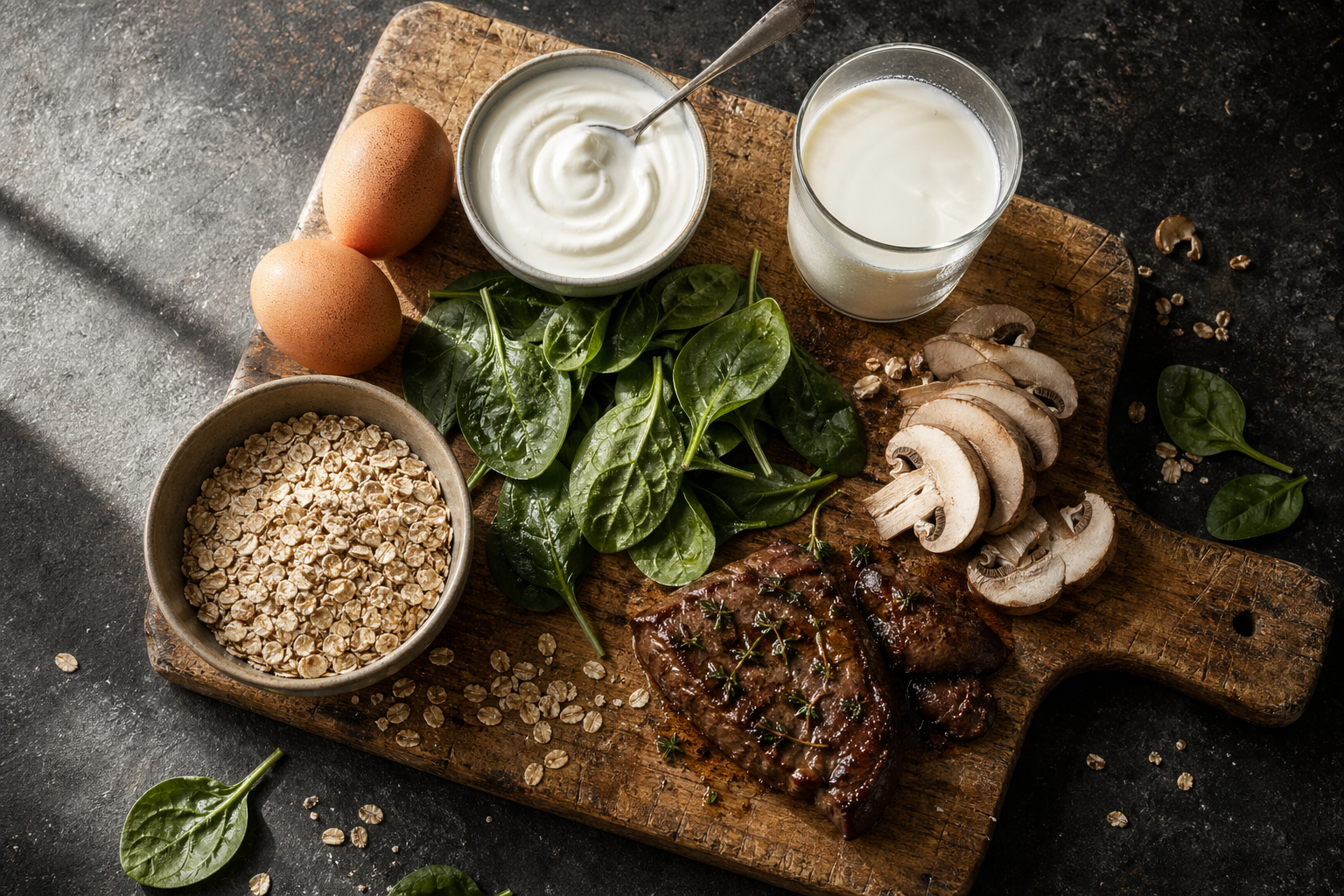
Rich food sources include milk and milk products, eggs, organ meats, lean meats, and fortified grains. In many diets, fortified grain products make a meaningful contribution to riboflavin intake, which helps explain why frank deficiency is uncommon in well-nourished populations. For most adults without a clear medical reason for high-dose therapy, improving diet or using a modest-dose supplement is more rational than starting with megadose products. NIH ODS — Riboflavin Fact Sheet; EFSA — Riboflavin dietary reference values
People more likely to fall short include those with very low dairy or animal-food intake, pregnant or lactating women with low animal-food intake, some vegetarian athletes, people with malabsorption or medically complex states, and those with rare riboflavin transporter deficiency or certain inborn metabolic disorders. Deficiency tends to affect tissues with high turnover and may present with sore throat, angular stomatitis, cheilosis, glossitis, seborrheic dermatitis, red or itchy eyes, skin lesions, and sometimes anemia if prolonged. NIH ODS — Riboflavin Fact Sheet; Review of riboflavin transporter and metabolic disorders; EFSA review on riboflavin absorption and requirements
Supplement form claims are often stronger than the evidence
The main consumer forms are free riboflavin and riboflavin-5′-phosphate. Although the phosphate form is often promoted as an activated version, current oral evidence does not show a clear clinically meaningful advantage for ordinary use. EFSA’s additive review reports that riboflavin-5′-phosphate sodium is rapidly dephosphorylated in the intestinal mucosa before entering normal riboflavin metabolism. A small pilot study also found similar serum riboflavin responses from “natural” and synthetic B-complex products, arguing against simplistic claims that one source is automatically more bioavailable than another. In practice, the reason for supplementing, the dose, and product quality appear more important than marketing language around form. EFSA opinion on riboflavin-5′-phosphate sodium; Pilot study of natural vs synthetic B-complex products
Adult migraine is the clearest higher-dose use
The most credible supplemental use of high-dose riboflavin beyond deficiency is adult migraine prophylaxis. The American Academy of Neurology and American Headache Society guideline classifies riboflavin as probably effective for episodic migraine prevention in adults, and recent evidence syntheses generally support a reduction in attack frequency. The most commonly discussed practical regimen is 400 mg/day for about 12 weeks. This should be understood as a targeted therapeutic-style protocol rather than as a routine wellness dose for the general public. AAN/AHS migraine prevention guideline; Systematic review of riboflavin monotherapy for migraine; Meta-analysis of dietary supplements for migraine prophylaxis
The migraine signal is supportive but not dramatic. Meta-analyses suggest benefits are more consistent for attack frequency than for severity or duration, and not every trial is positive. Pediatric evidence is more mixed, so children and adolescents should not simply copy adult 400 mg regimens without clinician input. The article’s practical stance is therefore balanced: riboflavin can be one of the better-supported nonprescription migraine options for adults, but it is not a proven cure and should be presented with realistic expectations. Systematic review of riboflavin monotherapy for migraine; Pediatric riboflavin migraine trial
Safety is favorable, but claims should stay within the evidence
Riboflavin has a favorable overall safety profile. Its water-soluble nature, limited absorption at high single doses, and urinary excretion help explain why toxicity reports are scarce and why no formal upper limit has been set by US or EU authorities. The most common visible effect of higher-dose use is bright yellow or yellow-orange urine, which is harmless but can surprise users. At the same time, the absence of a formal upper limit does not prove that unlimited intake is harmless; it reflects insufficient evidence to define a threshold. NIH ODS — Riboflavin Fact Sheet; Pediatric riboflavin migraine trial; EFSA review on riboflavin absorption and requirements
Regulatory frameworks also limit what can be claimed. In the US, riboflavin is sold as a dietary supplement and may carry substantiated structure/function claims, but not disease-treatment claims. In the EU, authorized claims focus on normal functions such as energy-yielding metabolism, nervous system function, skin, and red blood cells when a product qualifies as a source of riboflavin. Neither framework gives riboflavin a standard approved claim for treating migraine. Broader claims, including routine blood-pressure lowering for the general population, remain premature outside special contexts such as the MTHFR 677TT genotype. FDA — Structure/function claims; EU Register — authorized riboflavin claims; BMC Medicine — JINGO MTHFR riboflavin review; 2025 review of riboflavin and blood pressure
Regulatory Status (EU and US)
United States
In the US, riboflavin is regulated as a dietary supplement ingredient rather than an approved drug for ordinary supplement use. Under FDA rules, companies may make substantiated structure/function claims, such as supporting energy metabolism, but they may not market riboflavin supplements as treating, curing, or preventing diseases unless the product meets the relevant authorization standards. US labels also use a Daily Value of 1.3 mg for adults and children aged 4 years and older, which helps show how far high-dose migraine products exceed ordinary nutritional reference values. FDA — Structure/function claims; FDA — Daily Value for riboflavin
European Union
In the EU, riboflavin can be used with authorized normal-function claims when a product qualifies as a source of the vitamin. These claims cover areas such as normal energy-yielding metabolism, normal nervous system function, maintenance of normal red blood cells, and maintenance of normal skin. Migraine-prevention claims are not standard authorized nutrient claims in this framework. Neither EFSA nor US authorities have set a formal upper limit, but that reflects insufficient data to derive one rather than proof that unlimited intake is harmless. EU Register — authorized riboflavin claims; EFSA opinion on riboflavin-5′-phosphate sodium; EFSA review on riboflavin absorption and requirements
Dosage and Standardization
Nutritional intake: US RDA is 1.1–1.3 mg/day; EFSA adult reference intake is 1.6 mg/day. Pregnancy and lactation needs are higher.
Studied adult migraine protocol: 400 mg/day for about 12 weeks. Absorption is saturable, so very high doses do not produce proportionally greater nutritional uptake.
Safety And Interactions
Riboflavin has a strong overall safety profile, and adverse effects have not been clearly established even in studies using 400 mg/day for several months. The most common noticeable effect is bright yellow, or sometimes yellow-orange, urine caused by excretion of excess vitamin. This is harmless but can be unexpected. No formal upper limit has been set, although that reflects limited harm data rather than proof that unlimited intake is safe. NIH ODS — Riboflavin Fact Sheet; Pediatric riboflavin migraine trial; EFSA review on riboflavin absorption and requirements
For interactions, NIH ODS states that no clinically relevant medication interactions are known. That is reassuring, but high-dose use should still be individualized in people with complex health conditions, those on multiple medications, pregnant or breastfeeding women considering migraine protocols, and children being considered for therapeutic-style dosing. Rare transporter deficiencies and certain inborn metabolic disorders may require high-dose use under specialist supervision. NIH ODS — Riboflavin Fact Sheet; Review of riboflavin transporter and metabolic disorders
Conclusion
Riboflavin is first and foremost an essential nutrient, not a miracle supplement. The science is strongest for its central role in energy metabolism and related coenzyme systems, and for preventing or correcting deficiency. For many people, food remains the main source of adequate intake.
Beyond basic nutrition, adult migraine prevention is the clearest evidence-based supplemental use, but the evidence is best described as supportive rather than definitive. Claims for universal energy enhancement, superior activated forms, or general blood-pressure lowering go beyond what the current evidence supports.
Disclaimer
Disclaimer: We attempt to do our best to find relevant, accurate and most up to date information available in both, the public domain and in the clinical and medical research community. We recommend reviewing scientific sources for official information on the subject. This post is not intended as medical advice. Each individual person's health conditions vary and we advise to consult a doctor before taking any supplements.