

 Deutsch
 Español
 Suomi
Suomi Français
 Bahasa Indonesia
 Italiano
 日本語
日本語 Português
 Tagalog

1. What is beta-alanine?
Beta-alanine is an amino acid, but not the kind your body uses to build proteins. Its best-known role is helping your body make carnosine.
Carnosine is stored mainly in skeletal muscle. During very hard exercise, your muscles produce hydrogen ions as part of normal energy metabolism. This contributes to the “burning” feeling and the drop in muscle pH that can make intense efforts harder to keep going. Carnosine helps buffer that shift.
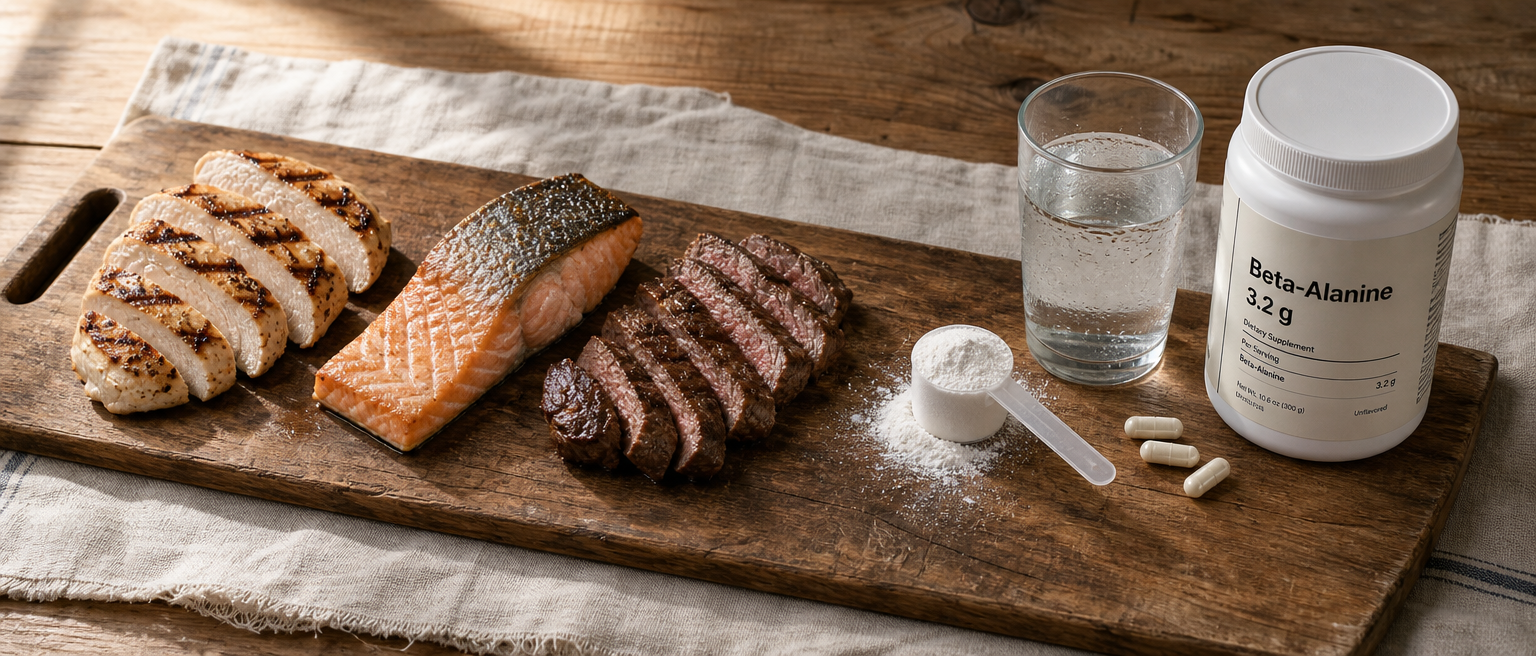
Your body makes beta-alanine in the liver, and you can also get small amounts from food. The main food sources are animal foods such as poultry, beef, pork, and fish. Vegans usually get little to no direct beta-alanine from food, although the body can still make it.
2. Is beta-alanine required by the body?
Beta-alanine is useful, but it is not “required” in the same way as vitamin C, iron, or the essential amino acids you get from protein. In nutrition terms, it is nonessential because the body can produce it.
That also means there is no well-defined deficiency disease caused by low beta-alanine intake. You do not see a classic syndrome like scurvy with vitamin C deficiency or anemia with iron deficiency.
The more practical question is muscle carnosine. People who eat little or no meat may have lower muscle carnosine on average than omnivores. That does not automatically mean they are unhealthy or clinically deficient. It may simply mean they have less of this particular muscle buffer available for very intense exercise.
3. How it works
Beta-alanine works gradually. It is not a “take it before the gym and feel stronger today” supplement.
After you take beta-alanine, your body combines it with another amino acid, histidine, to make carnosine inside muscle cells. Research shows beta-alanine availability is the limiting factor in this process. Put simply, when more beta-alanine is available, muscles can usually store more carnosine.
That is why most studies use daily beta-alanine for several weeks. Muscle carnosine builds over time, and any exercise benefit is expected to come from that longer-term increase.
4. What the evidence says
The strongest evidence is for a small performance benefit in high-intensity exercise that lasts long enough for fatigue to build. Think rowing pieces, track cycling, repeated hard intervals, combat-sport rounds, CrossFit-style tests, or running efforts where fatigue builds quickly.
 Small benefits are clearest in hard efforts lasting roughly 30 seconds to 10 minutes.
 Effects may be most likely in efforts lasting about 1–4 minutes, with some evidence clearer after about 4 weeks.
 Evidence is weaker for long endurance exercise and repeated sprint ability.
It helps to separate what beta-alanine has been shown to do from the claims often attached to it.
Beta-alanine is not well supported as a fat-loss supplement. A GRADE-assessed systematic review found no meaningful effect on body weight, fat mass, body-fat percentage, or fat-free mass.
It is not a proven muscle-building supplement on its own. If someone trains harder because beta-alanine helps them tolerate a specific type of intense work, that may indirectly support training quality. But beta-alanine itself has not been shown to reliably add muscle.
It is not a general energy supplement. It does not work like caffeine, and most people will not feel an immediate performance lift.
For older adults, early research suggests beta-alanine may improve exercise capacity in some cases, but the studies are few and small. Evidence for improving strength or everyday functional performance is not consistent yet.
Non-sport health claims — including possible roles in diabetes markers, chemotherapy-related symptoms, oral mucositis, gut protection, or Helicobacter pylori treatment support — are still preliminary. These are research questions, not established reasons to supplement.
5. Practical considerations
- Use pattern: Most research uses beta-alanine daily rather than only on training days.
- Dose: Common evidence-based ranges are about 4–6 grams per day, divided into smaller doses, for at least 2–4 weeks. Some studies continue for 8–12 weeks.
- Timing: Timing is less important than consistency. Because the goal is to raise muscle carnosine, taking it every day is more important than taking it right before exercise.
- Tolerance: If you are new to beta-alanine, you may tolerate it better by starting lower, splitting doses across the day, or using a sustained-release form.
- Food sources: Meat, poultry, and fish are the richest common sources because they contain carnosine and related compounds that can supply beta-alanine.
Even so, typical food intake is much lower than research supplement doses. Estimated daily intake may range from none in vegans to around 1 gram per day in heavy meat eaters.
6. Safety
Short-term beta-alanine use appears generally safe in healthy adults at studied doses. The most common side effect is tingling, prickling, flushing, or itching of the skin. This is called paresthesia. It can feel odd, but it is usually temporary and harmless.
This tingling is more likely with larger single doses, especially around 800 mg or more at one time. Splitting the dose or choosing a sustained-release product can reduce it.
Long-term safety data are more limited. Most studies last weeks to months, and data beyond about one year are not strong. There are also gaps for pregnancy, breastfeeding, adolescents, people with significant medical conditions, and those taking multiple medications.
One theoretical concern from animal research is that very high beta-alanine intake might affect taurine, another amino acid-like compound. Human studies so far have not shown a meaningful reduction in muscle taurine at typical supplement doses, but it is another reason not to exceed evidence-based amounts.